UNDERSTAND
YOUR HEART
WITH THE SPECIALISTS WHO TREAT IT
Every condition explained by the cardiologist who treats it. No acronyms. No anxiety. Just clarity.
Meet the Cardiologists
Behind Every Word
Every condition guide is written, reviewed, and signed by a practicing specialist. Not a content team.

"I explain coronary artery disease to my patients the same way I explain it to residents — with honesty about what we know and humility about what we're still learning."
"Atrial fibrillation terrifies patients because they can feel their heart misbehaving. My job is to turn that fear into understanding, and then into a plan."

"Valve disease is often silent for years, then suddenly urgent. I wrote these guides so patients understand the window between discovery and decision."

"Heart failure has the worst name in medicine — it sounds like giving up. I've spent twenty years helping patients understand it's actually a manageable chronic condition."
Your Diagnosis,
Explained Fully
Every entry below was written by the cardiologist who specializes in treating it. Tap any condition to go deeper — from plain-language overview to clinical protocol.
Imagine your coronary arteries as garden hoses supplying water to your heart muscle. Coronary artery disease happens when a waxy substance called plaque — made of cholesterol, fat, and calcium — builds up inside those hoses, gradually narrowing them. Your heart doesn't get the blood flow it needs, especially when it's working hard. That's when you feel chest pressure, shortness of breath, or fatigue with exertion.
Chest pressure during exertion, jaw or left arm discomfort, unexplained shortness of breath, or sudden crushing chest pain (call 911 immediately).
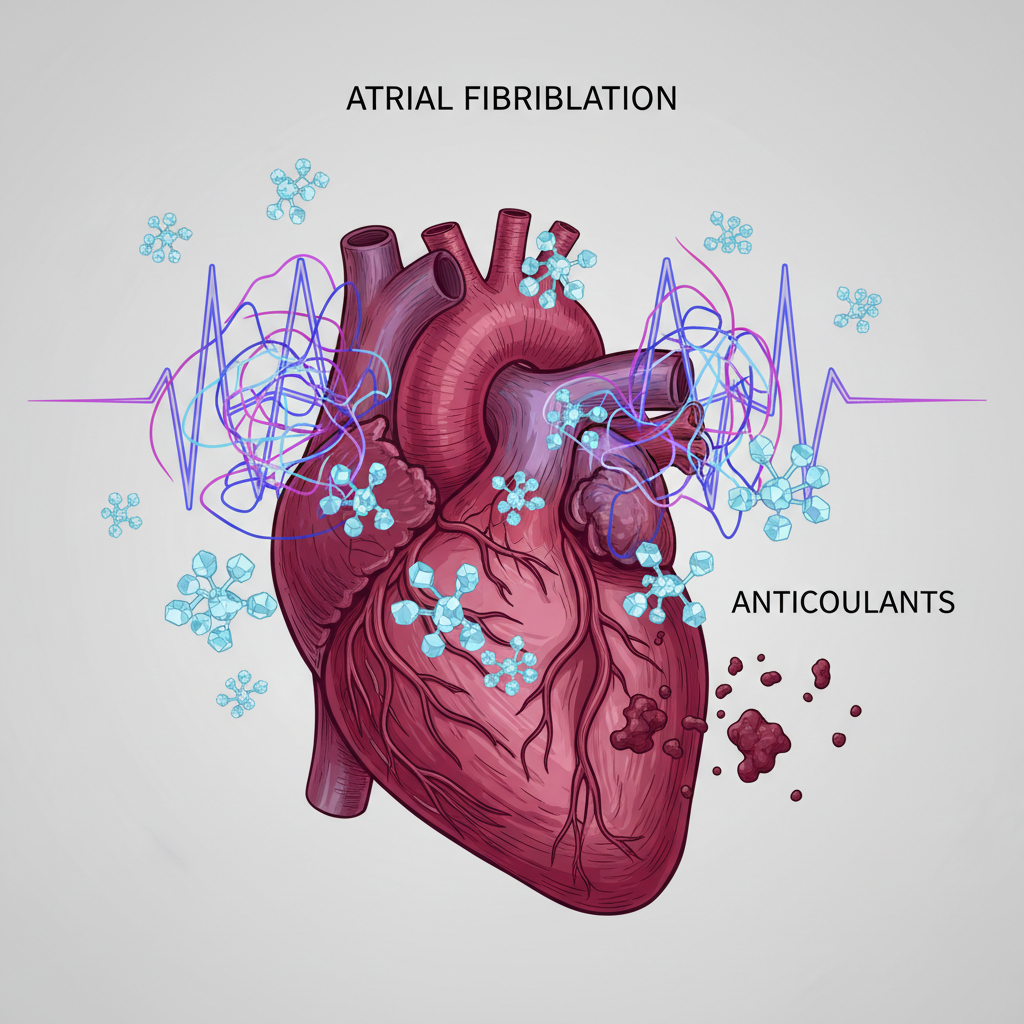
Your heart has an electrical system that coordinates every beat. In atrial fibrillation, the upper chambers of your heart (the atria) receive chaotic electrical signals instead of one organized impulse. Instead of squeezing efficiently, they quiver — like a bag of worms, as electrophysiologists sometimes describe it. You might feel this as palpitations, a fluttering sensation, fatigue, or shortness of breath. Or you might feel nothing at all and only discover it on a routine ECG.
Palpitations lasting more than a few minutes, sudden dizziness, unexplained fatigue, or any episode of one-sided weakness or slurred speech (stroke symptoms — call 911).
Percutaneous coronary intervention — stenting — is how we open a blocked coronary artery without open-heart surgery. We thread a thin, flexible catheter through an artery in your wrist or groin, navigate it to the blockage, inflate a tiny balloon to compress the plaque, and leave behind a small metal mesh tube (the stent) to hold the artery open. Most patients go home the next day. You'll feel the artery open — some describe a warm sensation in the chest — and for many people, the angina they've lived with for months simply disappears.
Post-procedure: call immediately for chest pain, bleeding at access site, or arm/leg changes. At follow-up, report new exertional symptoms — they may indicate in-stent restenosis.
Your aortic valve is the door between your heart and the rest of your body. It opens with every heartbeat to let blood out, then snaps shut to prevent backflow. Aortic stenosis is what happens when calcium deposits stiffen and narrow that door over decades. Your heart has to squeeze much harder to push blood through the smaller opening. For years, the heart compensates silently. Then symptoms appear — typically a triad of chest pain with exertion, fainting episodes, and shortness of breath. At that point, the valve needs to be addressed.
Exertional chest tightness, fainting or near-fainting, or new shortness of breath with activities that used to feel easy. If you have a known murmur, ask your doctor when your last echocardiogram was.
"Heart failure" is the most frightening name for a condition that most people live with for decades. It doesn't mean your heart has stopped or is about to stop. It means your heart muscle isn't pumping as efficiently as it should — either because it's become stiff (HFpEF) or because it's stretched and weakened (HFrEF). Your body responds by retaining fluid, which causes the swollen ankles and breathlessness you might notice. With the right medications and monitoring, most patients with heart failure lead full, active lives. The goal is to keep your heart compensated.
Rapid weight gain (>2–3 lbs in a day or 5 lbs in a week), worsening ankle swelling, needing extra pillows to sleep, or shortness of breath at rest.
Catheter ablation for AFib is how we silence the electrical misfires causing your irregular heartbeat. I thread thin catheters from a vein in your groin up into the heart's upper chambers. Using either radiofrequency energy (heat) or cryotherapy (cold), we create small scars around the pulmonary veins — the usual source of AFib triggers. Those scars act as electrical insulators, blocking the chaotic signals from reaching the rest of the atrium. The procedure takes 2–4 hours. Most patients go home the next morning. For paroxysmal AFib, about 70–80% of patients are free of significant AFib at one year.
Post-ablation: call for fever, palpitations worse than pre-procedure, or any stroke symptoms. The first 3 months are a "blanking period" — some AFib during this time doesn't mean the procedure failed.
Book a Cardiology
Consultation
You've read the explanation. Now talk to the cardiologist who wrote it. Three questions. Fifteen minutes to connect you with the right specialist.